
Edwards Deed Types and Uses
The Edwards County Register of Deeds keeps the county's official deed records. A deed names the parties and describes what changed hands, and its form shapes what the buyer actually receives. Beyond deeds, the office records mortgages, oil and gas leases, plats, UCC filings, federal and state tax liens, powers of attorney, maps, and other official papers that touch Edwards County land.
| Deed Type | What It Does | Common Use |
|---|---|---|
| Warranty deed | Conveys an interest with deed warranties | A conventional sale or transfer |
| Quitclaim deed | Conveys whatever interest the signer has | Family transfers or curing a possible claim |
| Trustee's deed | Shows a transfer through a trustee | Trust administration or sale |
| Sheriff's or tax deed | Records a transfer tied to a legal sale | Foreclosure or tax-sale research |
| Plat or addition | Creates or depicts recorded lots and blocks | Subdivision and description work |
Recording a deed gives public notice. That is all it does. It does not vouch for the truth of every clause, rule out other interests, or turn a quitclaim into a warranty deed. So read the granting language, the parties, the legal description, the dates, and any references or releases as one connected set.
Edwards Deed Index Access
Edwards County publishes no online deed index. It offers no historical image portal. There is no stated grantor-grantee cutoff. So begin with the ORKA parcel card for a current owner and legal description. Then take the request straight to the Register of Deeds. The office sits at 312 Massachusetts Avenue in Kinsley. Mail goes to PO Box 264, Kinsley, KS 67547. It opens weekdays from 8:00 a.m. to 5:00 p.m., except holidays.
Phone, email, mail, and an in-person visit all work. Ask which index years, deed books, images, or office terminals are open to you. A sharp request names the parcel, the instrument type, the parties, and a date range. Kansas law allows electronic recording, but that does not put public images online.
Open the official recorder page to confirm access details before you call or visit.
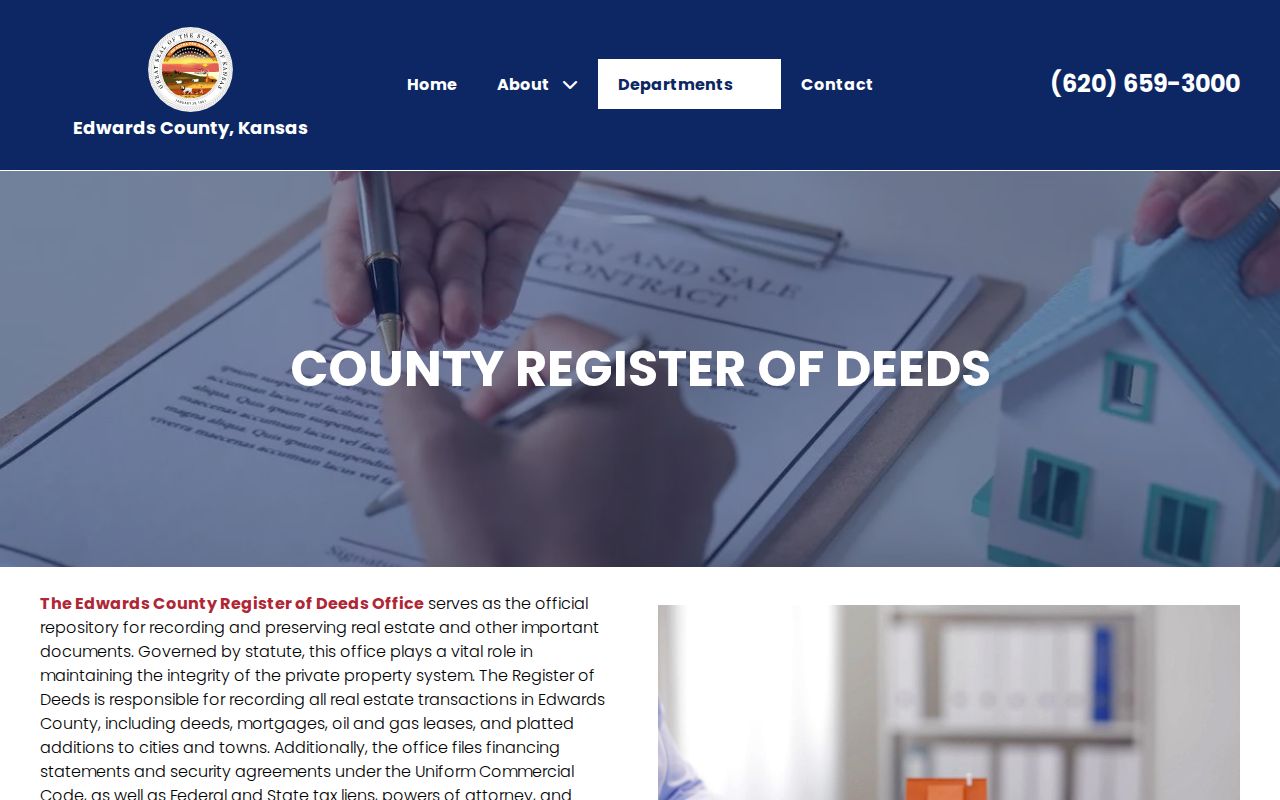
The Register of Deeds page itself shows the office-based route and the full instrument list. Coverage and copy prices still take a direct question.
Begin with Edwards Parcel Details
Start in Edwards ORKA before you ask for deed records. Note the KSPID, the owner shown, and the location. Also note the mailing address, boundary description, city or township, and taxing unit. KSPID is the 19-digit Kansas parcel identifier. It makes a strong match key. The legal description still anchors any title research on Edwards County property records.
One county sample reads Kinsley Original Town, Block 14, two acres, all of Block 14. It includes a vacated alley. That phrase explains why a map shape may not look like a normal street lot. Keep the exact wording, then request the related plat or road-vacation record rather than assuming anyone owns the alley.
Note: A current ORKA owner field is an appraisal snapshot and cannot supply the full recorded chain of title.
Follow Edwards Grantor-Grantee Names
A grantor conveys the interest. A grantee takes it. Begin with the current deed, then hunt the earlier deed by which that same grantor acquired the tract from someone before. Repeat the cycle, checking each legal description, date, and reference against the last, until the chain of Edwards County deed records runs back as far as you need.
- Give the recorder the current grantee, legal description, KSPID, and a recent date range.
- Record the prior grantor, deed type, recording date, and book/page or instrument number.
- Search that grantor as an earlier grantee for the same land.
- Repeat backward, adding probate transfers, plats, corrections, releases, and name variants.
- Flag any break, conflicting description, or unexplained party change for professional review.
- Grantor
- The party conveying the stated interest.
- Grantee
- The party receiving that interest.
- Chain of title
- The connected sequence of instruments affecting the tract.
- Book/page
- A volume and page reference used to retrieve a record.
- Instrument number
- A unique filing reference when assigned by the office.
Edwards County has published no instrument-number format and no earliest index year. Ask the office which reference applies to each period.
Trace Edwards Deed Encumbrances
Deed records carry more than transfers. A careful Edwards County property search also covers mortgages and releases, assignments, easements, restrictions, plats, tax liens, powers of attorney, and oil and gas leases where they apply. A later release often cites the earlier mortgage by book, page, or instrument number.
An easement lets someone use land for a stated purpose without owning the parcel. A plat maps the lots, blocks, and streets of a subdivision. Neither can be read off a line on ORKA. Request the actual document and match its legal description against the deed.
Older Edwards Deed Records
When the office index stops short, ask the recorder about deed books. Ask also about maps and the earliest surviving index. Edwards County's exact deed-book chronology is not published. Kansas Historical Society reel coverage is not published either, so no start date should be guessed.
The Kansas Historical Society microfilm guide lists statewide microfilm and interlibrary-loan access to county records. Its Archives Catalog searches by keyword, title, creator, material type, and date. Most holdings stay undigitized. An archival entry is only a lead until it matches a county instrument.
Kinsley Public Library keeps local-history material. Its shelves hold early city tax rolls, directories, maps, newspapers, and vertical files. These tie a person or place to an era. They complement, but never replace, deed records.
Note: No documented courthouse fire, deed reconstruction, or local imaging cutover was found, so do not infer a gap without office evidence.
Electronic Edwards Deed Records
K.S.A. 58-4404 allows electronic recording. The core indexing duties stay intact. It governs how a county receives and indexes an electronic document. It promises no public remote search, no images, and no online start date.
So ask where the item lives. That may be an electronic index, an office terminal, a deed book, or microfilm. A missing public link never proves a deed does not exist.
Request Edwards Deeds Precisely
Precision matters more than volume in a deed request. Give the Register of Deeds the parcel number, legal description, and the city or township. Add grantor and grantee names. Add the instrument type and an approximate date. Include any book, page, or instrument reference already in hand. Ask for an index entry first when the filing is unknown. That single step often pins down the right tract among similar names. Edwards County staff can then pull the exact deed. No guessing across a shelf of related filings.
Recording fees follow the statutory schedule in K.S.A. 28-115. Edwards County publishes no flat local copy charge. Confirm plain-copy and certified-copy prices, plat fees, search costs, and postage. Verify accepted payment before sending money. A focused KORA request can also ask about format and an estimate.
Choose an Edwards Deed Copy
Decide which version of the deed you actually need. A plain copy works for reading and research. A certified copy carries the recorder's certification and is often required for formal use. Tell the office which one you want. Ask whether mail or email delivery is offered, and whether every page and exhibit must be included.
At the counter, bring parcel details and the party list. For mail or email, state your delivery address and request an estimate first. A phone call can confirm the custodian, while a written request preserves exact spellings. The county contact form serves as a routing fallback when nothing else connects.
Recorded, not guaranteed. Edwards County deed records show filed instruments, not a legal opinion that title is clear. Unrecorded interests or indexing errors may require a current professional title search.
Keep the deed, its index entry, the parcel card, and the map source dated together. When something does not match, resolve it with the custodian rather than picking whichever record looks easiest.
Edwards Deed Request Checks
Before closing any deed-records request, compare each copied reference against the parcel summary. Party spellings, initials, entity suffixes, and trust or estate labels can shift between instruments. A street address can change too. The legal land description remains the thread linking filings, so lean on it. Search a reasonable span on both sides of the expected transfer date.
A chain that appears to jump may be explained by a probate instrument, court order, corrective deed, merger, parcel split, or recorded plat. Ask about those possibilities. Kansas CaseSearch can surface a public property-related case lead, but the courthouse record and the recorder filing must be checked separately. Never treat a docket event as the recorded conveyance itself. For long searches, keep a simple chronology listing recording date, execution date, grantor, grantee, deed type, legal description, and reference. That log helps Edwards County staff spot a gap. It also keeps two similarly named tracts from being merged by mistake.
Edwards Deeds and Court Transfers
Not every ownership change looks like a routine sale. Probate, partition, quiet-title, foreclosure, and tax proceedings all generate court records. Those records explain why a new party appears in the deed chain. Edwards District Court sits in the 24th Judicial District. Kansas CaseSearch provides public case information and events within its access limits.
Search by party name, case number when known, and a date range tied to the unexplained transfer. Then turn to the Edwards County courthouse terminal for documents the portal does not carry. A focused clerk request is another option. Sealed and restricted material stays unavailable. A court file can explain an order. But the instrument recorded with the Register of Deeds remains the land-record link. Keep the court case number beside the later recorder reference.
A probate order, sheriff-sale confirmation, or quiet-title judgment may describe parties differently. The owner string on ORKA may not match. Matching the legal description and recording reference keeps that name difference from breaking the chain of title.